Wicked Company: The Forgotten Radicalism of the European Enlightenment by Blom Philipp
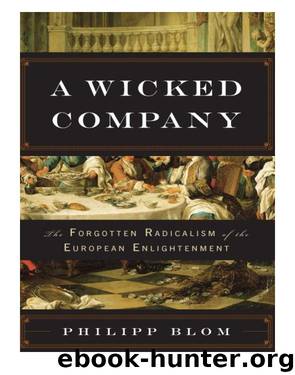
Author:Blom, Philipp [Blom, Philipp]
Language: eng
Format: epub
Tags: Biography
ISBN: 9780465022786
Google: hFEa7773xAIC
Barnesnoble:
Goodreads: 9599521
Publisher: Basic Books
Published: 2012-05-08T07:28:03+00:00
Holbach’s moralizing friends and their very private lies and relationships and the private face of Diderot, unhappy about having to wear the coat of the Great Philosopher, had an essential element in common: the danger of falling hostage to their growing reputations, and the difficulties of living up to them.
They were becoming famous now even outside of France, even if they were no fixed group, no circle, no club, and their opinions diverged widely. Not all of Holbach’s guests were atheists or published books, not all Encyclopedists visited the rue Royale, and not all regulars wrote for the Encyclopédie. Even the names given to the dinners and discussions varied widely, indicating the continuing openness of the salon.
Rousseau had branded the friends “Holbach’s coterie,” and had accused them of plotting against him. The baron himself simply invited people chez moi, and Diderot speaks in his letters about dining chez le baron. On other occasions, he calls the rue Royale the Synagogue of the Enlightenment. Diderot used the original sense of the word “synagogue” as a place of assembly, but his choice of word was also with an ironic acknowledgment of the at-times-almost-religious fervor of their atheist sermons. Another aspect of the group’s activities was accentuated in Diderot’s affectionately designating the group the Boulangerie. This obviously referred to the scientist Nicolas-Antoine Boulanger, who had attended the dinners before his early death in 1759 and had posthumously lent his name to Holbach’s Christianity Unveiled, which was published with the intentionally misleading addition “by the late M. Boulanger” under the title. But the word boulangerie also conjured up another image: a busy workshop, constantly mixing and kneading, and pulling dangerous books out of the oven as if they were so many hot baguettes.
David Hume had his own, ironically affectionate name for the friends and their salon: the Sheikhs of the rue Royale,5 and while they were no oriental potentates, the comparison was just insofar as, during the 1760s, more and more foreigners would knock at the baron’s gates. These ambassadors from other Enlightened countries and groups (some of them actually were diplomats) came armed with a letter of recommendation, or just with a winning smile. They were always admitted.
Download
This site does not store any files on its server. We only index and link to content provided by other sites. Please contact the content providers to delete copyright contents if any and email us, we'll remove relevant links or contents immediately.
| Africa | Americas |
| Arctic & Antarctica | Asia |
| Australia & Oceania | Europe |
| Middle East | Russia |
| United States | World |
| Ancient Civilizations | Military |
| Historical Study & Educational Resources |
Underground: A Human History of the Worlds Beneath Our Feet by Will Hunt(12099)
Sapiens by Yuval Noah Harari(5371)
Navigation and Map Reading by K Andrew(5158)
The Sympathizer by Viet Thanh Nguyen(4390)
Barron's AP Biology by Goldberg M.S. Deborah T(4150)
5 Steps to a 5 AP U.S. History, 2010-2011 Edition (5 Steps to a 5 on the Advanced Placement Examinations Series) by Armstrong Stephen(3734)
Three Women by Lisa Taddeo(3434)
Water by Ian Miller(3187)
The Comedians: Drunks, Thieves, Scoundrels, and the History of American Comedy by Nesteroff Kliph(3079)
Drugs Unlimited by Mike Power(2594)
A Short History of Drunkenness by Forsyth Mark(2297)
DarkMarket by Misha Glenny(2212)
And the Band Played On by Randy Shilts(2210)
The House of Government by Slezkine Yuri(2206)
The Library Book by Susan Orlean(2071)
Revived (Cat Patrick) by Cat Patrick(1992)
The Woman Who Smashed Codes by Jason Fagone(1973)
The Absolutely True Diary of a Part-Time Indian by Sherman Alexie(1913)
Birth by Tina Cassidy(1905)
